Thursday, March 7, 2013

Ref: Jonah in Judaism

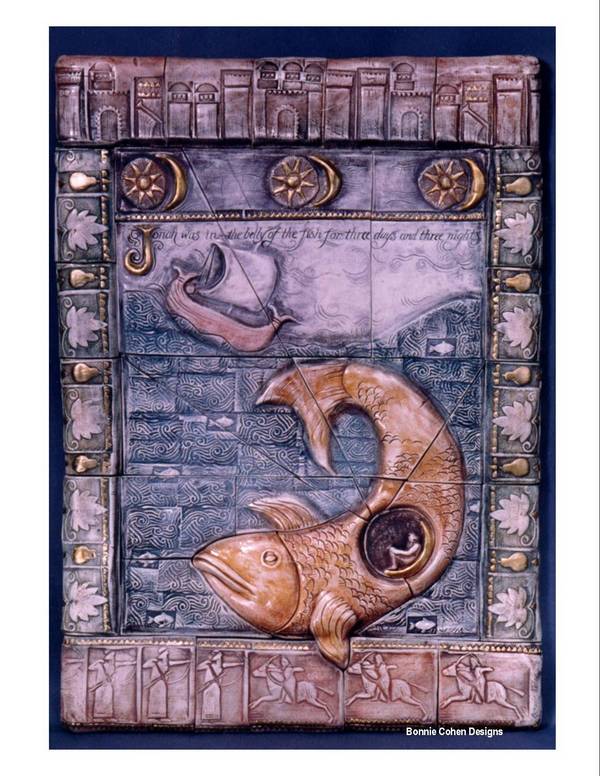
Bonnie Cohen's work, "Jonah," above, was selected as an image for the Rosh HaShanah cards published by Women of Reform Judaism. The original has been exhibited in several museums both Jewish and secular around the country as well.
AGJA Newsletter


Wikipedia tells:

The book of Jonah (Yonah יונה) is one of the 12 minor prophets included in the Tanakh. According to tradition Jonah was the boy brought back to life by Elijah the prophet, and hence shares many of his characteristics (particularly his desire for 'strict judgment'). The book of Jonah is read every year, in its original Hebrew and in its entirety, on Yom Kippur - the Day of Atonement, as the Haftarah at the afternoon mincha prayer.

Teshuva - the ability to repent and be forgiven by God - is a prominent idea in Jewish thought. This concept is developed in the book of Jonah: Jonah, the son of truth, (The name of his father "Amitai" in Hebrew means truth,) refuses to ask the people of Nineveh to repent. He seeks the truth only, and no forgiveness. When forced to go, his call is heard loud and clear. The people of Nineveh repent ecstatically, "fasting, including the sheep", and the Jewish scripts are critical of this.

When praying, Jonah repeats God's 13 traits failing to say the last one which is "...and Truthful", and changing it with "...and who is willing to forgive the bad". God responds by showing Jonah that he is "angry at doing good", and that he too would agree to spare an ephemeral plant if it has importance for him.

See also the wikipedia article on Jonah in rabbinic literature

Ref: Shrine of Jonah in Nineveh

"Tomb of Jonah" Nineveh, Iraq
Image PhotoCollection

Mosque of Nebi Younis "Jonah"
On one of the two most prominent mounds of Nineveh ruins, rises the Mosque of Prophet Younis "Biblical Jonah" (pbuh), the son of Amittai, from the 8th century BC which is believed to be the burial place of him, and where King Esarhaddon had once built a palace.

This old shrine standing on the site of a Christian church is a mere stone's throw from the built-up walls and gates of Nineveh.

In the middle of the Mosque stood a Sepulcher, covered with a Persian carpet of silk and silver, and at the four corners, great copper candlesticks with wax tapers, besides several lamps and ostrich shells that hung down from the roof. A whale's tooth, appropriate to Jonah's well-known adventure at sea, is said to be preserved there.


The sanctuary of Jama Naballa Jonas is another place that tradition says is Jonah's grave, near the city of Mosul (today in Iraq), near the ancient remnants of Nineveh. On one of the two most prominent mounds of Nineveh ruins, rises the Mosque of the Prophet Yunus (previously a Nestorian-Assyrian Church). Jonah is believed to be buried here, where King Esarhaddon had once built a palace. It is one of the most important mosques in Mosul and one of the few historic mosques that are found on the east side of the city.


Ref: Muhammad

Prophets Jonah and Jeremiah, destroyed Jerusalem
Ottoman miniature art 1583
Museum of Turkish and Islamic Arts in Istanbul
image wikimedia


Wikipedia tells:

Jonah is also mentioned in a few incidents during the lifetime of Muhammad. In some instances, Jonah's name is spoken of with praise and reverence by Muhammad.

According to historical narrations about Muhammad's life, after ten years of receiving revelations, Muhammad went to the city of Ta’if to see if its leaders would allow him to preach his message from there rather than Mecca, but he was cast from the city by the people. He took shelter in the garden of Utbah and Shaybah, two members of the Quraysh tribe. They sent their servant, Addas, to serve him grapes for sustenance. Muhammad asked Addas where he was from and the servant replied Nineveh. "The town of Jonah the just, son of Amittai!" Muhammad exclaimed. Addas was shocked because he knew that the pagan Arabs had no knowledge of the prophet Jonah. He then asked how Muhammad knew of this man. "We are brothers" Muhammad replied. "Jonah was a Prophet of God and I, too, am a Prophet of God." Addas immediately accepted Islam and kissed the hands and feet of Muhammad.

In one of the sayings of Muhammad, in the collection of Imam Bukhari, it says that Muhammad said "One should not say that I am better than Jonah". This is understood by both mainstream Muslims and historians to have been stated by Muhammad to emphasize upon the notion of equality between all the prophets and the law of making no distinction between any of the messengers. The Arab tribes, of the time, may have begun to exalt Muhammad above Jonah because of the recent revelation Muhammad received, which recounted the story of Jonah's fleeing from his mission. Thus, Muhammad, by saying this, clearly made it a point to the Arabs to not make any distinction between the great apostles of God.
wikipedia


Ref: Jonah in Islam

Verse 38 from Surah 10 Yunus
Jonah (Yunus in Arabic) is highly important in Islam as a prophet who was faithful to God and delivered His messages. In Islam, Jonah is also called Dhul-Nun (Arabic: ذو النون; meaning The One of the Whale).

Chapter 10 of the Qur'an is named Jonah, although in this chapter only verse 98 refers to him directly. It is said in Muslim tradition that Jonah came from the tribe of Benjamin and that his father was Amittai. Jonah is the only one of the Twelve Minor Prophets of the Hebrew Bible to be mentioned by name in the Qur'an.

Jonah's Qur'anic narrative is extremely similar to the Hebrew Bible story. The Qur'an describes Jonah as a righteous preacher of the message of God but a messenger who, one day, fled from his mission because of its overwhelming difficulty. The Qur'an says that Jonah made it onto a ship but, because of the powerfully stormy weather, the men aboard the ship suggested casting lots to throw off the individual responsible for this supposed 'bad luck'. When the lots were cast, Jonah's name came out, and he was thrown into the open ocean that night. A gigantic fish came and swallowed him, and Jonah remained in the belly of the fish repenting and glorifying God to the maximum. As the Qur'an says:
So also was Jonah among those sent (by Us).
When he ran away (like a slave from captivity) to the ship (fully) laden,
He (agreed to) cast lots, and he was condemned:
Then the big Fish did swallow him, and he had done acts worthy of blame.
Had it not been that he (repented and) glorified Allah,
He would certainly have remained inside the Fish till the Day of Resurrection.
—Qur'an, chapter 37 (As-Saaffat), verse 139-144
God forgave Jonah out of His mercy and kindness for the man, and because he knew that Jonah was, at heart, one of the best of men. Therefore, the fish cast Jonah out onto dry land, with Jonah in a state of sickness. Thus, God caused a plant to grow where Jonah was lying to provide shade and comfort for him. After Jonah got up, fresh and well, God told him to go back and preach at his land. As the Qur'an says:
But We cast him forth on the naked shore in a state of sickness,
And We caused to grow, over him, a spreading plant of the gourd kind.
And We sent him (on a mission) to a hundred thousand (men) or more.
And they believed; so We permitted them to enjoy (their life) for a while.
—Qur'an, chapter 37 (As-Saaffat), verse 145-148
wikipedia

Jesus and Jonah

Jesus was deeply familiar with the Book of Jonah and raised it to one of the more significant books in His Bible, our Old Testament.

The awesome march of the dead - the Men of Nineveh:
"The men of Nineveh will stand up at the judgment with this generation and condemn it, for they repented at the preaching of Jonah; and now something greater than Jonah is here."
Luke 11:32
The mysterious unscientific very hard-to-believe Sign of Jonah which Jesus talks about almost in spitting way but which in fact is the greatest divine Sign humanity has ever received:
"A wicked and adulterous generation looks for a sign, but none will be given it except the sign of Jonah.” Jesus then left them and went away.
Matthew 16:4
But what is the true meaning of the Sign of Resurrection From the Dead On the Third Day?

The marvelous gem of religious literature, Book of Jonah, does contain the answer but not in expressis verbis. Rather, it runs as an underpinning in the contents of the entire book - allahu rahman urahim.

The answer is given explicitly in the New Testament in the Gospel of John chapter 3 verse 16
For God so loved the world that he gave his one and only Son, that whoever believes in him shall not perish but have eternal life.

odium theologicum


Did God's laborious treatment of Jonah succeed?

Did Jonah turn into an Assyrians loving religious person praising the Lord for His mercy even towards those who sin.

A kind of second Abraham, who dared to bargain with God to save the deeply sinning Sodom and Gomorrah?

We do not know.


And here is part of the power in the writing of the Book of Jonah: it makes us to think without providing easy off-the-self answers.

This is so perhaps because the illness of religious hatred is so difficult to heal.

We know from the history of the Christian Church so many deep tragedies and catastrophes that have been caused by religious ire, odium theologicum. Just listing some of them would be a truly distressing and depressing job.

There is no worse hatred than religious hatred justified in the Name of the Father.

Book of Jonah suggests that not direct talk but indirect riddles, symbols and signs can provide a person with the way out from such state of mind. Visual art, music, theater, movies that do not dare to jump to the illogical and the world of myths, fairy tales, dreams and psychological imagery.

It is possible that Jonah was left in that pit of hatred, depression and death wish even after the logical verbal explanation God gave him about His care for Nineveh.

But we, the readers of the Book of Jonah, are left with much to ponder...

exactly because the Book of Jonah has no proper ending.

Surprising end to the Book of Jonah

The Book of Jonah is actually about Jonah and not about Nineveh and the hundred thousand Assyrians living in the city plus the animals.

It is a surprisingly modern masterpiece of literature from Ancient Near East which in few words draws an unforgettable picture so full of meanings, symbols and signs.

The most ravishing feature of the Book of Jonah is its ending.

It has no proper ending.

First the book tells about all the acts of God through Nature to influence the man - raising a storm, influencing the minds of the sailors, sending a big fish to swallow the drowning man and having it vomit him just in the right place on dry land, growing a leafy plant and sending a worm into it, raising a scorching sun.

Great Mother Nature at work for a single man, the angry and obstinate Jonah who hates bad people.

Secondly, the book tells about the Words of God that are minimalistic, to say the least. Unlike the other books of prophets filled with words of God from beginning to end, here the sentences are terse to the point of a cartoon. Yet they are meaningful and powerful. (A literary critic might complain about the limited range of expressions given to Mr Jonah in the book).

There is the underlying theme of psychotherapy, to use a modern term, of helping a man drowning in his utter hatred and also anger at God who does not know how to hate properly wrongdoers.

This deep hatred is in my opinion best explained as a post-Holocaust feeling, a Jew living after Auschwitz where all his family was gassed and their bodies burned to ashes. The horrible Assyrian conquest of the Northern Kingdom and the fall of Samaria in 701 BC.

Well, Nature put to work for the deeply angry and fatally depressed Mr Jonah, God Himself talking to him in soothing voice.

At the end of the book containing very terse sentences God speaks at  relative length about the meaning of the Sign of the Leafy Plant.

So what happens to Jonah after this extensive treatment and symbolic acts and meanings trying to get him out of the deep pit of pure hatred.

We do not know.

We really do not know!


Strange therapy for a depressed man

Depressed and very angry Jonah sat to the east from the city and builds a booth, in Hebrew סכּה sukka. From its shadow he was watching what will happen to Nineveh. The awful time of forced preaching was over and the stupid citizens repented. But perhaps there was still a change that God would change His mind and Nineveh would be destroyed by fire and brimstone raining from heaven. Jonah sat and waited.

Instead of just trying to talk with Jonah, the chosen messenger who had turned out to be a very stubborn and difficult character, God takes some action to help him out of his depression.

FIRST STEP
In an act of kindness God the Therapist grows a leafy plant to give Jonah better shadow. [The Hebrew word is קיקיון qiqayon of uncertain meaning. King James Version translated it as (nauseous) gourd.]


So where did the booth disappear?  Is there a logical break between the two paragraphs or should we see the (presumably) leafy qiqayon plant as a significant addition to the protection from heat Jonah's own boot had provided?


Result: Jonah was exceedingly happy about this plant.

SECOND STEP


Reversing the act of kindness God prepares (מנה manah) a worm ( תּולע tol'eah) to strike (נכה nakah) the pleasant plant and it withered.


Nice going, God, real psychotherapy to help a distressed sad man!

And as if that is not enough, the Great Helper did this:
"When the sun rose, God provided a scorching east wind, and the sun blazed on Jonah’s head so that he grew faint." 
Jonah 4:8

Huh. This already sounds like soft torturing of mind and body.
Result Jonah wanted to die


THIRD STEP
The Healer next discusses the events with the patient:
God said to Jonah, “Is it right for you to be angry about the plant?”
Jonah 4:9 

The question is rather similar to the real issue at hand but concerns something much more simple and manageable, the fate of a plant that grew up yesterday and died today.

Jonah is as angry about the death of the plant as he is angry about God's mercy to the Assyrians:
“It is,” he said. “And I’m so angry I wish I were dead.”
Jonah 4:9 

Single minded fellow, isn't he?

That does not seem to lead to anything but God continues giving explanation to the parable of the leafy plant and the worm - the meaning of the Sign.

But the Lord said, “You have been concerned about this plant, though you did not tend it or make it grow. It sprang up overnight and died overnight. And should I not have concern for the great city of Nineveh, in which there are more than a hundred and twenty thousand people who cannot tell their right hand from their left—and also many animals?”
Jonah 4:10-11 

Result: we do not know! 

What a surprising description of a therapy session...

God's mercy as His guilt

Jonah is angry to the point of wanting to die. Lord forced him to preach repentance and the damned people believed the message and repented in ash and sackcloth.

What could be worse?

And of course, God who is rahman urahim, goes on and forgives them instead of destroying Nineveh as they deserve.

This is an extremely deep theological teaching that is also extremely hard for us humans to accept.

Surely, God is a tool of our vengeance to those who seriously harmed us?

Surely, God hates those, who do not believe the way I believe?

Surely, God is a figment of my mind and does what I think a real God would do in order to make me satisfied!

Unfortunately, God bares the guilt of mankind.

Nothing but hatred

But to Jonah this seemed very wrong, and he became angry.

He prayed to the Lord, “Isn’t this what I said, Lord, when I was still at home? That is what I tried to forestall by fleeing to Tarshish. I knew that you are a gracious and compassionate God, slow to anger and abounding in love, a God who relents from sending calamity.

Now, Lord, take away my life, for it is better for me to die than to live.”

But the Lord replied, “Is it right for you to be angry?”
Jonah 4:1-4


Jonah is so angry that he would rather be dead.


He has the full freedom of a person to express his total disappointment and anger at God.

Instead of hitting him with divine lightning Lord simply asks “Is it right for you to be angry?”

Simple question, yes, but very difficult to answer.


Book of Jonah does continue from this point as a verbal discourse, philosophy of theodicy or the like.

Instead, in the following section words are combined with objects and actions that work as signs.

This is a truly powerful and unforgettable way to say things! Jesus of Nazareth had good command of this style His words and parables being choke full of objects, places and people.


Allahu rahman urahim
Daily Muslim prayers contain this sentence, one of the few allowed for describing Allah - that God is gracious and compassionate. These words are originally from the Bible and appear also here in the Book of Jonah.

חנּוּן hanun - gracious
רחוּם rachum - merciful


Fruits of Repentance

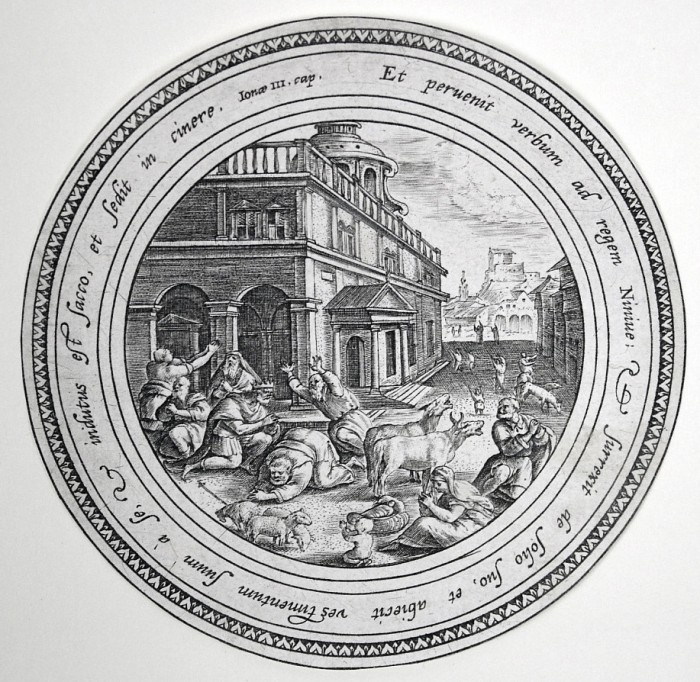
When Jonah’s warning reached the king of Nineveh, he rose from his throne, took off his royal robes, covered himself with sackcloth and sat down in the dust. This is the proclamation he issued in Nineveh:

“By the decree of the king and his nobles:

Do not let people or animals, herds or flocks, taste anything; do not let them eat or drink. But let people and animals be covered with sackcloth. Let everyone call urgently on God. Let them give up their evil ways and their violence. Who knows? God may yet relent and with compassion turn from his fierce anger so that we will not perish.”

When God saw what they did and how they turned from their evil ways, he relented and did not bring on them the destruction he had threatened.
Jonah 3:6-10
King of Nineveh repents
The King and the People of Nineveh Repenting c. 1586
Crispin de Passe, Maarten de Vos
Image Harris Schrank Fine Prints
When Jonah’s warning reached the king of Nineveh, he rose from his throne, took off his royal robes, covered himself with sackcloth and sat down in the dust.
Jonah 3:6 

What a reaction from the great king of Nineveh!
Somewhat similar situation is described in the Second Book of Kings that may actually be related to the Book of Jonah more than in one way.


King Josiah repents
When the king heard the words of the Book of the Law, he tore his robes. He gave these orders to Hilkiah the priest, Ahikam son of Shaphan, Akbor son of Micaiah, Shaphan the secretary and Asaiah the king’s attendant: “Go and inquire of the Lord for me and for the people and for all Judah about what is written in this book that has been found. Great is the Lord’s anger that burns against us because those who have gone before us have not obeyed the words of this book; they have not acted in accordance with all that is written there concerning us.”

Hilkiah the priest, Ahikam, Akbor, Shaphan and Asaiah went to speak to the prophet Huldah, who was the wife of Shallum son of Tikvah, the son of Harhas, keeper of the wardrobe. She lived in Jerusalem, in the New Quarter.

She said to them, “This is what the Lord, the God of Israel, says: Tell the man who sent you to me,  ‘This is what the Lord says: I am going to bring disaster on this place and its people, according to everything written in the book the king of Judah has read. Because they have forsaken me and burned incense to other gods and aroused my anger by all the idols their hands have made, my anger will burn against this place and will not be quenched.’  Tell the king of Judah, who sent you to inquire of the Lord, ‘This is what the Lord, the God of Israel, says concerning the words you heard: Because your heart was responsive and you humbled yourself before the Lord when you heard what I have spoken against this place and its people—that they would become a curse[b] and be laid waste—and because you tore your robes and wept in my presence, I also have heard you, declares the Lord. Therefore I will gather you to your ancestors, and you will be buried in peace. Your eyes will not see all the disaster I am going to bring on this place.’”

So they took her answer back to the king.
2 Kings 22:14-20


King Josiah ruled c. 649–609 BC which is during the time of the conquest of Nineveh in 612 BC.


Second round - Jonah 3

Then the word of the Lord came to Jonah a second time: “Go to the great city of Nineveh and proclaim to it the message I give you.”
Jonah 3:1-2

Now Lord spoke slightly differently from the first round when He had said
“Go to the great city of Nineveh and preach against it, because its wickedness has come up before me.”
Jonah 1:2

Wickedness of a city reaching the abode of God is a theme also in the case of Sodom and Gomorrah from which "outcry has reached me":

Then the Lord said, “The outcry against Sodom and Gomorrah is so great and their sin so grievous that I will go down and see if what they have done is as bad as the outcry that has reached me. If not, I will know.” 
Gen 18:20-21

This time Jonah obeyed the word of the Lord and went to Nineveh.


END IS NEAR!
Now Nineveh was a very large city; it took three days to go through it. Jonah began by going a day’s journey into the city, proclaiming, “Forty more days and Nineveh will be overthrown.” 
Jonah 3:3-4

A huge city, a New York of its time, and a single stranger walking and carrying a placard End is near!

But as Jonah had been afraid from the beginning his preaching was not ridiculed and ignored but taken very seriously:


Great city repents

The Ninevites believed God. A fast was proclaimed, and all of them, from the greatest to the least, put on sackcloth.
Jonah 3:5

As an external sign of repentance from evil and wickedness the people follow the public call for a fast, a kind of Ramadan in Nineveh, and put on sackcloth. 

שׂק saq
properly a mesh (as allowing a liquid to run through), that is, coarse loose cloth or sacking (used in mourning and for bagging); hence a bag (for grain, etc.): - sack (-cloth, -clothes).
Strong's Hebrew Dictionary


Wednesday, March 6, 2013

Jonah and Psalm 139

Wings of the Dawn
Sunrise at Atlantic
Image Edupic

Poor Jonah, he really had no chance in this wrestling with God.

For it is absolutely fatally written in Psalm 139


1 You have searched me, Lord,
    and you know me.
2 You know when I sit and when I rise;
    you perceive my thoughts from afar.
3 You discern my going out and my lying down;
    you are familiar with all my ways.
4 Before a word is on my tongue
    you, Lord, know it completely.
5 You hem me in behind and before,
    and you lay your hand upon me.
6 Such knowledge is too wonderful for me,
    too lofty for me to attain.

7 Where can I go from your Spirit?
    Where can I flee from your presence?
8 If I go up to the heavens, you are there;
    if I make my bed in the depths, you are there.
9 If I rise on the wings of the dawn,
    if I settle on the far side of the sea,
10 even there your hand will guide me,
    your right hand will hold me fast.
11 If I say, “Surely the darkness will hide me
    and the light become night around me,”
12 even the darkness will not be dark to you;
    the night will shine like the day,
    for darkness is as light to you.

13 For you created my inmost being;
    you knit me together in my mother’s womb.
14 I praise you because I am fearfully and wonderfully made;
    your works are wonderful,
    I know that full well.
15 My frame was not hidden from you
    when I was made in the secret place,
    when I was woven together in the depths of the earth.
16 Your eyes saw my unformed body;
    all the days ordained for me were written in your book
    before one of them came to be.

17 How precious to me are your thoughts, God!
    How vast is the sum of them!
18 Were I to count them,
    they would outnumber the grains of sand—
    when I awake, I am still with you.

19 If only you, God, would slay the wicked!
    Away from me, you who are bloodthirsty!
20 They speak of you with evil intent;
    your adversaries misuse your name.
21 Do I not hate those who hate you, Lord,
    and abhor those who are in rebellion against you?
22 I have nothing but hatred for them;
    I count them my enemies.

23 Search me, God, and know my heart;
    test me and know my anxious thoughts.
24 See if there is any offensive way in me,
    and lead me in the way everlasting.


-------
You cannot easily escape your maker, oh Jonah!

My frame was not hidden from you
    when I was made in the secret place,
    when I was woven together in the depths of the earth.
Your eyes saw my unformed body;
    all the days ordained for me were written in your book
    before one of them came to be.


Being an honest religious man is good...

Do I not hate those who hate you, Lord,
    and abhor those who are in rebellion against you?
I have nothing but hatred for them;
    I count them my enemies.


To the end of the world? Tartessus in Spain

Tartessos cultural area
image wikimedia
But Jonah ran away from the Lord and headed for Tarshish. He went down to Joppa, where he found a ship bound for that port. After paying the fare, he went aboard and sailed for Tarshish to flee from the Lord.
Jonah 1:3 NIV
The Jewish Encyclopaedia article on the Book of Jonah identifies the destination of the ship Tarsis as Tartessus in Spain.

Wikipedia tells about this possible Atlantis
Tartessos (Greek: Ταρτησσός) or Tartessus was a harbor city and surrounding culture on the south coast of the Iberian peninsula (in modern Andalusia, Spain), at the mouth of the Guadalquivir River.

It appears in sources from Greece and the Near East starting in the middle of the first millennium BC, for example Herodotus, who describes it as beyond the Pillars of Heracles (Strait of Gibraltar).

Roman authors tend to echo the earlier Greek sources, but from around the end of the millennium there are indications that the name Tartessos had fallen out of use, and the city may have been lost to flooding, though several authors attempt to identify it with cities of other names in the area.

Archaeological discoveries in the region have built up a picture of a more widespread culture, identified as Tartessian, that includes some 97 inscriptions in a Tartessian language.

The Tartessians were rich in metal. In the 4th century BC the historian Ephorus describes "a very prosperous market called Tartessos, with much tin carried by river, as well as gold and copper from Celtic lands". Trade in tin was very lucrative in the Bronze Age, since it is an essential component of true bronze, and comparatively rare.

Herodotus refers to a king of Tartessos, Arganthonios, presumably named for his wealth in silver.

The people from Tartessos became important trading partners of the Phoenicians, whose presence in Iberia dates from the 8th century BC, and who nearby built a harbor of their own, Gadir (Greek: τΓάδειρα, Latin: Gades, present-day Cádiz).
wikipedia

Phoenician ships might well have stopped at Joppa to take paying passengers travelling to Spain. But instead of the five hundred km to Tarsis the trip would have been about as far away as one can get, to the end of the known world actually.

As far away as Jonah could possibly travel.


The end of the world


Region of Santiago de Compostella
For ancient Iberians and than for the Romans the end of the world was the Atlantic coast west of Santiago de Compostella in the NW corner of Spain. There opened the ultimate sea that surrounds all land and even the sailors of Christopher Columbus were afraid of falling off the world if their boats reached too far west where sun sets.

The  world famous pilgrimage of Santiago de Compostella has strong prehistoric taste to it and maybe yet another ancient Iberian cultural tradition that was baptised with the arrival of Christianity.  (The nearby northern areas till the shores of Gulf of Biscay are inhabited continuously by the Basque people considered the earliest Europeans).


Tarsis or Tartessus?
Well, to be honest - I do not know! (need to study more the matter...)

But as for the question would Tartessus be more dramatic and to the point in the Book of Jonah than good old Tarsis my answer is a resounding YES!

Tarsis is in the close neighbourhood of Nineveh.

When you try to run away from God, good man, get as far as you can get!

And even that may not be enough for it is written in Psalm 139...


Where can I go from your Spirit?
Where can I flee from your presence?

If I go up to the heavens, you are there;
if I make my bed in the depths, you are there.

If I rise on the wings of the dawn,
if I settle on the far side of the sea,
even there your hand will guide me,
your right hand will hold me fast.

If I say, “Surely the darkness will hide me
and the light become night around me,”
even the darkness will not be dark to you;
the night will shine like the day,
for darkness is as light to you.
Ps 139:7-12 NIV


Tuesday, March 5, 2013

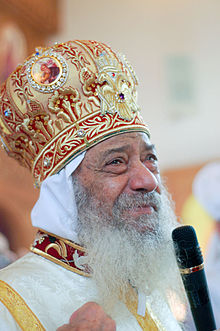
IntLib: Jonah - Pope Shenoudah III

Pope Shenoudah III
Image wikimedia

"Pope Shenouda III (1923–2012) was the 117th Pope and Patriarch of the Church of Alexandria. His episcopate lasted 40 years, four months, and 4 days from 14 November 1971 until his death on 17 March 2012. His official title was Pope of Alexandria and the Patriarch of All Africa on the Holy Apostolic See of Saint Mark the Evangelist of the Coptic Orthodox Church of Alexandria. He was also the head of the Holy Synod of the Coptic Orthodox Patriarchate of Alexandria."
wikipedia


Contemplations on the Book of Jonah 
Saint Takla Church, Alexandria Egypt
Jonah and the Whale
Image Coptic Art
The Book of Jonah the Prophet is full of wonderful spiritual contemplation. Our aim in this book is to tackle purely the spiritual side, and not the theological side. Our aim is to benefit and not to debate. We wish to take from this beautiful Book beneficial lessons for our life. We wish to benefit from God's work and from people's virtues and faults.

How beautiful is the Church's choice! She chose this Book to be the prelude of the forty days of Lent! A beautiful story of repentance and fasting precedes the Great Lent by two weeks, that we may approach the holy forty days with a clean heart attached to the Lord.
Pope Shenoudah III

IntLib: Jonah in Jewish Encyclopaedia (1906)

The Jewish Encyclopaedia
Image governmentauction
By IntLib  - Internet Library - I mean the world wide web that began as military Arpanet and has had many other forgotten names only a gopher knows, such as Usenet... With the power of search engines IntLib allows us to know almost anything. It brings us not only references to published books but access to so many on line publications on almost any subject that nobody has time or energy to read but a small selection of them (the Professor Syndrome).


The Book of Jonah article in the Jewish Encyclopaedia (1906) is very detailed and includes valuable information and points of view from the early period of Biblical scholarship. I warmly recommend reading it and discuss here only two points - hermeneutic settings and dating.

Hermeneutic settings

Book of Jonah does not explicitly tell why Jonah was so angry at God. The theme of post-Holocaust bitterness against Assyrians I am proposing is totally absent from the 1906 Jewish Encyclopaedia article because despite of European anti-Semitism the horrors and emotions caused of Assur where not so vividly understood as after Auschwitz.


The Peircean ground on which Book of Jonah is studied in the article is that of the general cultural optimism at the turn of the 20th century and full Jewish assimilation to German life, including academic institutions and spirit of the time.

The writer is comfortable with the ideas of modern Biblical scholarship that had began only some decades before. Bible study became scientific in late 19th century in the same way so many other branches of knowledge were transformed with the introduction of Hegelian concepts of historical processes in time, layered structures of texts and evolution of society and religion.

At the time of the writing of the article on Jonah Western world was enjoying a great period of optimism; science, technology and growing economy would solve all the problems of humanity. There is no discussion on existential anxiety that marks post-WW 1 Europe but a rather dry listing of facts and critical study with many details.

In 1906 when the article was published European Jewry was enjoying the Goldene Stadt not only in Prag but also elsewhere in Central Europe having, for example, leading positions as scholars in many academic institutions in Germany.

The fundamental message of the Book of Jonah is not particularly exciting to this commentator who duly notes the point that also gojim can be good people and interestingly compares the stories of Ruth and Jonah. To deliver this - rather generic humanitarian message - someone wrote a Jewish midrash style book that is included in the prophets only because of its name.


Dating the Book of Jonah
The author of the article proposes very late date for the composing of the Book of Jonah.
Only Esther, Chronicles, and Daniel are of later date.

Again, the way in which Nineveh is referred to shows that the city had long since vanished from the face of the earth and had faded into legend (comp. iii. 3). The King of Nineveh, also (iii. 6), could have been referred to only in a late myth; and the legendary atmosphere of the whole story, from beginning to end, is in accord with the length of time that had elapsed since the events recounted took place. This becomes evident both in the episode of the fish which swallows a man and then casts him up alive after three days, and in that of the plant which in one night grows high enough to overshadow Jonah.

These things might, it is true, be considered as divine miracles; but such an explanation can not be offered for the three days' time that it takes to pass through Nineveh (iii. 3), nor for the fasting, sackcloth, and penitent cries of the animals (iii. 7 et seq.), much less for the conception that an Israelitish prophet could preach penitence to the city of Nineveh, and that the king and the citizens would listen to him. Everything about the story is, and was intended to be, miraculous and legendary.
Jewish Encyclopaedia
In those days radical dating of the books of the Bible was in full swing in Exegetics and highly learned "aber Ich lese..." men were busily correcting Masoretic tradition where it seemed that texts had been corrupted during the lengthy period of manual copying of manuscripts.

One of the key argument for late dating is, however, in the apparently legendary nature of Nineveh and its king. Scholars were thinking that the city had been forgotten and is a kind of imaginary place, a Shangri la so to say, where entire people repent.

The fall of Nineveh was not forgotten in the Persian or even Hellenistic period: our main historical resources about the events come from classical authors writing in the Antiquity. Nineveh was unforgettable as Hiroshima of those days.

Consequently, the catastrophic fall of Nineveh fits badly with the core message of the Book of Jonah and either this is intentional irony or the book dates to the time before 612 BC.


Monday, March 4, 2013

Isaiah - Temple of God

Jews long to rebuild the Temple of Jerusalem
image Christian Life Ministries

When my life was ebbing away,
I remembered you, Lord,
and my prayer rose to you,
to your holy temple.
Jonah 2:7 NIV

We get more understanding of the awe and spiritual meaning of the Temple of God mentioned in the prayer of Jonah from the vision of Isaiah. Scholars commonly think that the vision of Isaiah is authentic. It may have taken place in the earthly Temple of Jerusalem as Isaiah was a long-time resident in the city and must have been a frequent visitor to the Temple. However, the vision has the feel of the Heavenly Temple that was considered the model according to which the earthly Solomon's Temple was built.*
In the year that King Uzziah died, I saw the Lord, high and exalted,seated on a throne; and the train of his robe filled the temple. 2 Above him were seraphim, each with six wings: With two wings they covered their faces, with two they covered their feet, and with two they were flying. 3 And they were calling to one another:

“Holy, holy, holy is the Lord Almighty;
the whole earth is full of his glory.”

At the sound of their voices the doorposts and thresholds shook and the temple was filled with smoke.
“Woe to me!” I cried. “I am ruined! For I am a man of unclean lips, and I live among a people of unclean lips, and my eyes have seen the King, the Lord Almighty.”

Then one of the seraphim flew to me with a live coal in his hand, which he had taken with tongs from the altar. With it he touched my mouth and said, “See, this has touched your lips; your guilt is taken away and your sin atoned for.”
Isaiah 6:1-4 NIV

______________________
*The Book of Exodus tells that Moses was shown on Mount Sinai a pattern, a model, according to which he was to construct the Tabernacle

“Then have them make a sanctuary for me, and I will dwell among them. Make this tabernacle and all its furnishings exactly like the pattern I will show you."
Exodus 25:8-9 NIV

“Then make its seven lamps and set them up on it so that they light the space in front of it. Its wick trimmers and trays are to be of pure gold. A talent of pure gold is to be used for the lampstand and all these accessories. See that you make them according to the pattern shown you on the mountain."
Exodus 25:37-40 NIV

Jonah's prayer - Back from the Pit

Jonah Leaving the Whale
Jan Brueghel the Elder, ca. 1600
Alte Pinakothek, Munich
Strangely contradictory is the way Jonah feels banished from the presence of God and yet hopes to see again the Temple. It is mentioned twice in the prayer.
I said, ‘I have been banished
from your sight;
yet I will look again
toward your holy temple.’
Jonah 2:4 NIV
Jonah was to be forever buried under earth at the very roots of mountains - but God had other plans for him.
To the roots of the mountains I sank down;
the earth beneath barred me in forever.
But you, Lord my God,
brought my life up from the pit.
Jonah 2:4 NIV

Jonah's prayer at the moment of death reflects the importance of the Temple of Jerusalem for Jews. It was the only place where sacrifices were allowed. It was commonly perceived as the abode of God among His people although there is quite heated discourse on the subject in the Bible emphasizing that the earthly temple was only a model of the one in Heaven.
When my life was ebbing away,
I remembered you, Lord,
and my prayer rose to you,
to your holy temple.
Jonah 2:7 NIV

Jonah' s prayer - Death by drowning

At the bottom of the sea
Image abspoel
In the first chapter we learned that Jonah himself asked sailors to throw him overboard into the stormy sea. Yet, in the prayer he says that it was God Himself who did this. The experience of the drowning man is agonizing and claustrophobic under all of God's waters and forever buried under the mountains. Particularly touching - and wet - is the detail: Seaweed was wrapped around my head
You hurled me into the depths,
    into the very heart of the seas,
    and the currents swirled about me;
all your waves and breakers
    swept over me.
...

The engulfing waters threatened me,
    the deep surrounded me;
    seaweed was wrapped around my head.
To the roots of the mountains I sank down;
    the earth beneath barred me in forever.
Jonah 2:3,5-6 NIV

Dispair and hope at the same time
The dying man is not hopeless as God hears his cry


In my distress I called to the Lord,
    and he answered me.
From deep in the realm of the dead I called for help,
    and you listened to my cry.

Jonah 2:1 NIV